| |
Bontekoe Journal/ Diary (Part 4)     |  | |
Bontekoe Short Information Sheet:
| Captain Bontekoe was a Dutchman who sailed the ocean in command of several Dutch V.O.C. ships in the early 17th century.
He never did anything remarkable as a navigator, he never discovered a new continent or a new strait or something great like that. He was blown up with his ship, flew heavenward, landed in the sea, and survived it to tell a tale of such harrowing bad luck that the world read his story for over four centuries with tearful eyes.
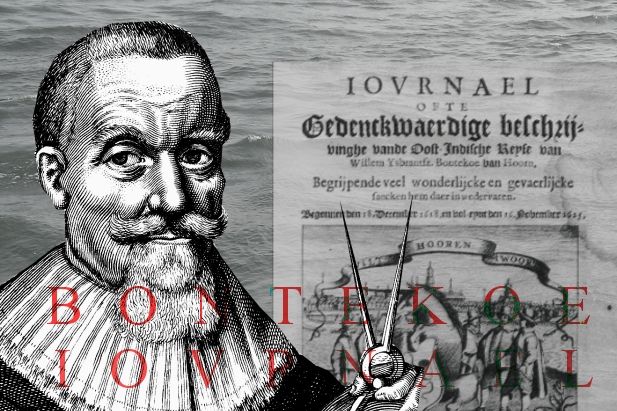
All is written in his famous diary/ journal, which was published in the year 1647. |
Holland History Information Cloud:
|
|
|
Bontekoe wandered about in a despondent mood, and when he saw a small hill he climbed to the top of it to be alone and to pray to the good Lord for his divine counsel. He prayed for a long time, and when at last he opened his eyes he saw that the clouds on the horizon had parted and that there was more land in the distance, and out of this he saw two bluish-looking mountains lifting their peaks. Suddenly he remembered that his friend, Captain Schouten, who had been in those parts of India, had often told him of two strange blue mountains which he had often seen in Java. He had sailed across the sea which separated Sumatra from Java, and the island on which he and his men now were was a little island off the coast of Java. He knew his way now, and he ordered his men to row as fast as they could. A boy was told to climb the mast and keep watch. And, behold! the next day the sailors suddenly saw a large Dutch fleet of twenty-three ships, under Frederik Houtman, who had left Texel with Bontekoe and was on his way to Batavia. He took all the men on board his ships. He fed them, gave them clothes, and carried them to Batavia, the newly founded capital of the Dutch East Indies, where the governor general, one Jan Pieterszoon Coen, received them very kindly, and appointed Bontekoe to be captain of a new ship, of thirty-two guns, which plied between the different colonies and carried provisions and supplies of war from Java to the other colonies.
It also brought to Java the granite which was necessary to build the strong fort where the government of the colony was to reside. Later on Bontekoe was made captain of another ship called the Groningen, and he visited China, where the Dutch company tried to capture the Portuguese colony in Macao and to build a fort on one of the Pescadores Islands to protect their Chinese trade. After two years of this work Bontekoe wanted to return home, and he asked to be given the command of a ship that was about to leave for Holland. He was given command of the Hollandia, which with two other ships left Batavia on the sixth of February of the year of our Lord 1625.
But Bontekoe's bad luck had not yet come to an end. This patient man, who never lost his temper and accepted everything that happened to him with devout resignation, once more became the victim of all sorts of unfortunate occurrences. On the 19th of March his ship was attacked by a terrible storm, and soon the waves threatened to swamp the vessel. Bontekoe ordered the men to work the pumps as hard as they could. Then the pepper stowed away in the hold broke loose, got into the pumps and clogged them. Finally baskets were placed about the lower part of the pumps to keep the pernicious pepper out of them, and the Hol- landia was saved. Of the other two ships, one, the Gouda, had disappeared when the morning came, and the other, the Middelburg, had suffered much. Her masts were broken, and they had no spare the Atlantic.
Finally the Middelburg left part of his spare yards for masts, and then he sailed with all possible haste for Madagascar to repair his own damage. He reached the island inside a week, and cut himself a mast out of a tree. He repaired his ship and spent a month on the island, where he was well received by the natives, who flocked from all over to see how the Hollanders made a new ship out of the wreck which they had saved from the storm. Here Bontekoe waited for the other ships. But the Gouda had sunk, and the other, the Middel- burg, reached Madagascar much later, and spent several months in the bay of Antongil. Most of her people were ill and among those who died on the island was the commander of the ship, Willem Schouten, who with Le Maire had discovered the new route between the Pacific and the Atlantic.
Finally the Middleburg left Madagascar and sailed to St. Helena. There she got into a fight with two Portuguese vessels, and that is the last word word we have ever re- ceived of her. As for Bontekoe, he, too, reached St. Helena, where he wanted to take in fresh water. But a Spanish ship had landed troops, and he was not allowed to come on shore. So he went farther on, and at last reached Kinsale in Ireland. This time the joys of life on land almost finished the brave captain who so often had escaped the anger of the waves. His sailors went on shore, and after the long voyage they appreciated the hospitality of the Irish inns so well that they refused to come back on board. They stayed on shore until the mayor of the city, at the request of Bontekoe, forbade the owners of ale-houses to give the Hollanders more than seven shillings' credit apiece. As soon as this was known the men, many of whom had spent much more than that, hastened back to their ship.
Crowds of furious innkeepers and their wives, crying aloud for their money, followed them. Good Captain Bontekoe paid everybody what he or she had a right to ask, and finally, on the twenty-fifth of November of the year 1625, he reached home. Bontekoe went to live quietly in his native city of Hoorn. He had written a short account of his voyage, but he had never printed it because he did not think that he could write well enough. But one of his fellow- townsmen wanted to write a large volume upon the noble deeds of the people of Hoorn, and he asked Bontekoe to write down the main events of his famous voyage, and he promised to edit the little book for the benefit of the reading public. And behold! this same public, saturated with stories of wild men and wild animals and ter- rible storms and uninhabited islands and treach- erous Portuguese and hairbreadth escapes, took such a fancy to the simple recital of Bontekoe's pious trip toward heaven and the patience with which he had accepted the vicissitudes of life that they read his little book long after the more ponderous volumes had been left to the kind ministrations of the meritorious book-form.
| |
|