| |
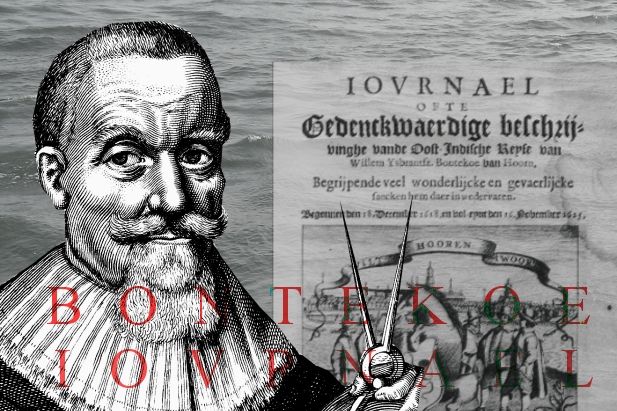
Bontekoe Journal/ Diary (Part 3)     |  | |
Bontekoe Short Information Sheet:
| Captain Bontekoe was a Dutchman who sailed the ocean in command of several Dutch V.O.C. ships in the early 17th century.
He never did anything remarkable as a navigator, he never discovered a new continent or a new strait or something great like that. He was blown up with his ship, flew heavenward, landed in the sea, and survived it to tell a tale of such harrowing bad luck that the world read his story for over four centuries with tearful eyes.
All is written in his famous diary/ journal, which was published in the year 1647. |
Holland History Information Cloud:
|
|
|
The men attacked these cocoanuts with such greedy hunger and they drank the sap with such haste that on the succeeding day they were all very ill, with great pains and a feeling that they might explode at any moment just as their ship had done. From the presence of this island Bontekoe argued that the coast of Sumatra must be about fifteen miles distant. He filled the boat with many cocoanuts, a wonderful fruit because it is food and drink at the same time, and sailed farther eastward. After seventy hours he ac- tually reached Sumatra, but the surf did not al- low him to land at once. It took an entire day before his men managed to row through that ter- rible surf, and then only at the cost of a swamped boat. At last, however, they did reach the shore, bailed out their boat, and made a fire to dry their clothes and to rest from the fatigue of this terrible experience. Some of the sailors meanwhile explored the country near by, and to their great astonishment they found the ashes of an old fire and near it some tobacco. This was very welcome, for the men had not smoked for many weeks.
They also found some beans. These they ate so greedily that they were all ill, and in the middle of the night, when they lay around groaning and moaning, they were suddenly attacked by the natives of the island. They had no arms, but they defended themselves as well as possible with sticks and pieces of burning wood which they picked up out of the fire. The natives fled, and the next morning sent three messengers to have a talk with the shipwrecked Hollanders. They wanted to know why he and his men had come to their island. They were told the story of the burning ship and the explosion which had killed many of the other sailors.
Bontekoe said that he was a peaceful traveler, and would pay for everything he bought. The natives believed this story, and came back with chickens and rice and all sorts of eatables, for which Bontekoe paid with money. The natives then told him that this land was Sumatra and that Java was a little farther to the east. They even knew the name of the governor-general, and Bontekoe now felt certain that he was on the right road to a Dutch harbor. Before he left he made a little trip up the river to buy more food, for he counted upon a long voyage in the small boat. This visit almost cost him his life. One day he had bought a carabao. He had paid for the animal, and told the four sailors who were with him to bring it to the camp; but the carabao was so wild that they could not manage it. The four sailors decided to spend the night in the village and try their luck once more the next morning, Bontekoe thought that this was too dangerous, and when his men refused to return to join the others, he hired two natives to paddle him back in their own canoe.
The natives told him the price for which they would row him back to the camp, and he gave them the required sum; but when they were out in the middle of the river they threatened to kill Bontekoe unless he gave them more money. Bontekoe said a short prayer and felt very uncomfortable. Then he heard a voice inside himself tell him to sing a funny song. This he did. He sang so loud that the noise resounded through the quiet forests on both sides of the river. The two natives thought that this was the funniest thing that they had ever heard, and they laughed so uproariously that they forgot all about their plan to kill the white man, and Bontekoe came safely back to his own people.
The next morning a number of natives ap- peared with a carabao, but Bontekoe saw at once that it was not the same one that he had bought the day before. He asked about it, and wanted to know where his men were. "Oh," the natives said, ''they are lazy and they will come a little later." This looked suspicious, but whatever happened, Bontekoe must have his carabao to be eaten on the trip across the Strait of Sunda. Therefore he tried to kill the animal, but when they saw this the natives suddenly began to call him names and they shrieked until several hun- dred others came running from the bushes and attacked the Hollanders. These fled back to their boat, but before they could reach it eleven men had been killed. Of those who scrambled 267 DUTCH NAVIGATORS on board one had been hit in the stomach with a poisoned arrow. Bontekoe performed an operation, trying to cut away the flesh around the wound, but he did not succeed in saving the life of the poor fellow. There were now only fifty-six men left. With only eight chickens for so many men Bontekoe did not dare to cross the strait. The next morning, armed, he went on shore, and, hav- ing gathered a lot of clams and filled the small barrels with fresh water, sailed away for the coast of Java. They sailed all day long, but at night there came so violent a wind that the sails had to be taken down, and the boat drifted whither it pleased the good Lord to send it. It pleased Him to bring it the next morning near three small islands densely covered with palm- trees. Out of the bamboo which grew near the shore several water-barrels were improvised. There was still some food, but not much. Therefore the discovery of these islands did not bring much relief to the poor shipwrecked peo- ple.
| |
|