| |
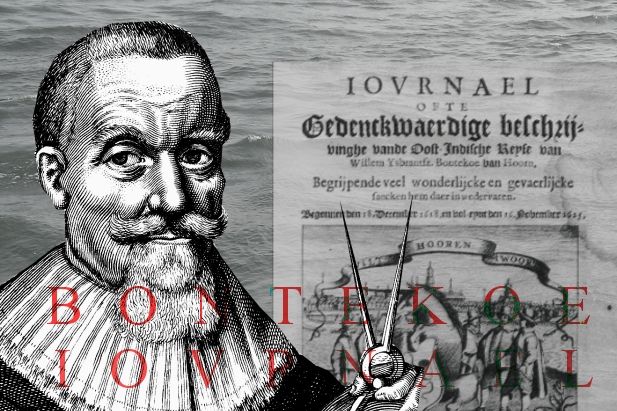
Bontekoe Journal/ Diary (Part 2)     |  | |
Bontekoe Short Information Sheet:
| Captain Bontekoe was a Dutchman who sailed the ocean in command of several Dutch V.O.C. ships in the early 17th century.
He never did anything remarkable as a navigator, he never discovered a new continent or a new strait or something great like that. He was blown up with his ship, flew heavenward, landed in the sea, and survived it to tell a tale of such harrowing bad luck that the world read his story for over four centuries with tearful eyes.
All is written in his famous diary/ journal, which was published in the year 1647. |
Holland History Information Cloud:
|
|
|
Both the boats were far away, and showed themselves only as small black dots upon the distant horizon. Bontekoe told his comrade to pray with him. For a long time they whispered their supplications to heaven. Then they looked once more to see what the boats were doing. And behold! their prayer had been answered. The boats came rowing back as fast as they could. When they saw the two men they tried to reach the wreckage; but they did not dare to come too near for their heavily loaded boats ran the risk of being thrown against the remains of the hulk. In that case they would have been swamped. 257 DUTCH NAVIGATORS Bontekoe had felt very happy as long as he had been up in the air.
Now, however, he began to notice that he had hurt his back badly and that he had been wounded in the head. He did not dare to swim to the boats, but the bugler of the ship, who was in the first boat, swam back to the wreckage, fastened a rope around Bonte- koe's waist, and in this fashion the commander was pulled safely on board, where he was made as comfortable as could be. During the night the two boats remained near the place of the misfortune because they hoped that they might find a few things to eat in the morning.
They had only a little bread and no water at all. Meanwhile the exhausted skipper slept, and when in the morning his men told him that they had nothing to eat he was very angry, for the day before the sea around his mast had been full of all sorts of boxes and barrels and there had been enough to eat for everybody. During the night, however, the boats had been blown away from the wreckage by the wind. There was no chance to get anything at all. Eight pounds of bread made up the total amount of provisions for seventy strong men. Of these there were forty-six in one and twenty-six in the second boat. Part of that bread was used by the ship's doctor to make a piaster for Bontekoe's wounds. With the help of a pillow which had been found in the locker of the biggest boat and which he wore around his head, Bontekoe was then partly restored to life, and he took command of his squadron and decided what ought to be done.
There were masts in the boat, but the sails had been forgotten. Therefore he ordered the men to give up their shirts. Out of these, two large sails were made. They were primitive sails, but they caught the breeze, and with the help of the western wind Bontekoe hoped to reach the coast of Sumatra, which, according to the best guess of all those on board, must be seventy miles to the east. All those who had the map 259 DUTCH NAVIGATORS of that part of India fairly well in their heads were consulted, and upon a piece of wood a chart of the coast of Sumatra, the Sunda Islands, and the west coast of Java was neatly engraved with the help of a nail and a pocket-knife. A few simple instruments were cut out of old planks, and the curious expedition was ready to navigate further eastward. Fortunately it rained very hard during the first night.
The sails made out of shirts were used to catch the rain, and the water was care- fully saved in two small empty barrels which had been found in one of the two boats. A drinking-cup was cut out of a wooden stopper, and each of the sailors in turn got a few drops of water. For many hours they sailed, and they became dreadfully hungry. Again a merciful Heaven came to their assistance. A number of sea-gulls came flying around the boats, and many of them ventured so near that they seemed to say ''Please catch us." Of course they were caught and killed, and although there was no way of cooking them, they were eaten by the hungry men as fast as they came. But a sea- gull is not a very fat bird, and again there was hunger, and not yet any sight of land. The big boat was a good sailor, but the small one could not keep up with her. Therefore the men in the small boat asked that they might be taken on board the big one, so that they might either perish together or all be saved.
The sailors in the large boat did not like the idea. They feared that their boat could not hold all of the seventy- six men. After a while, however, they gave in. The men from the small boat v^ere taken on board. Out of the extra oars a sort of deck w^as rigged up on top of the boat, and under this a number of the men were allowed to sleep while the others sat on top and looked for land or prayed for food and water. No further sea-gulls came to feed this forlorn expedition, but just when they were so hungry that they could not stand it any longer, large shoals of flying-fish suddenly jumped out of the water into the boats. Again the men were saved.
The two little barrels of water had been emptied by this time. For the second time the men expected that they would all perish. They sailed eastward, but they saw no land, and finally they got so hungry and thirsty that they talked about killing the cabin boy and eating him. Bontekoe asked them please not to do it, and he prayed the good Lord not to allow this horrible thing to happen. The men, however, said that they were very hungry and must have some- thing to eat. Then he asked that they should wait just three days more. If no land was seen after three days, they might eat the cabin boy. On the thirteenth day after the explosion there was a severe thunder-storm, and the barrels were filled with fresh water. Most of the men then crept under the little cover to be out of the rain, and only one of the mates was left on deck. It was very hazy, but when the fog parted for a moment he saw land very near the boat. The next morning the survivors reached an uninhab- ited island, where there was no fresh water, but an abundance of cocoanut-trees.
| |
|