Discover the fascinating & rich history of the country of Holland, also known as The Netherlands.

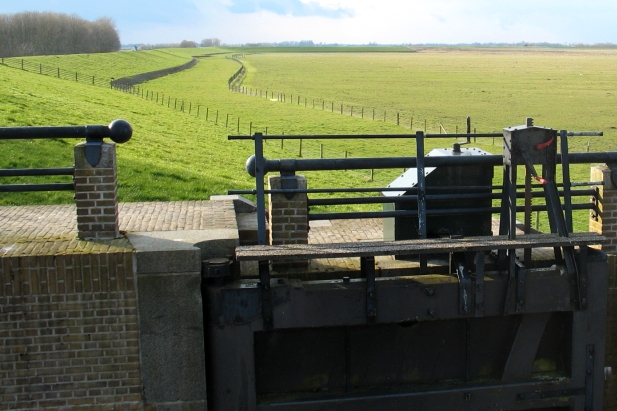
Dutch sluice and dyke at Ezumazijl, Friesland, The Netherlands
Holland and the sea
A sluice in the province of Friesland in The Netherlands.


Holland and the sea

   
Holland History Short Information Sheet:



Holland History Information Cloud:


Most of the Netherlands are below sea level. It will be readily understood that the dykes are a very important feature of the country, and some of these are well worth examination and study, if the visitor have plenty of time on his hands. For the most part these dykes are composed of earth and sand and clay, kept together by wil- lows which are carefully planted and tended.

Some of the dykes, however, for example the gigantic one at Den Helder, are built of masonry. Many of them are broad at the top, and, being paved with klinkers (brick) , form very good carriage roads. The dunes or sand hills which line the coast serve as the barrier against the ocean. They are systematically sown at regular intervals with a coarse, grayish green grass, which holds the sand together, preventing the wind from blowing it away altogether.

Millions of euros are spent annually by the Dutch government in keeping these dykes in order, and a special body of engineers, called "De Waterstaat," is appointed to look after them. An elaborate system of drainage has also to be maintained by means of powerful engines, pumps, etc.

It must be remembered that the Dutch people have not only to fight against the inroads of the ocean, but they have also to deal with many rivers which, taking their rise in other countries, flow through Holland for their final exit into the sea. Consequently, when there are heavy rains, say in Germany, the Rhine brings down an immense volume of water to add to the troublesome superfluity.

Two important canals are the North Holland Canal, which was constructed in 1819-1825, from Amsterdam to Den Helder, and which is forty-six miles in length, one hundred and thirty feet broad, and twenty feet in depth, and of a width varying from sixty-five to one hundred and ten yards. Here are locks, consisting of large basins, which are tremendous pieces of engineering. Their construction cost the State an enormous sum.

The Merwede Canal has an average width of about one hundred feet, and is something like forty-four miles in length.

Holland, country & city | Holland History | Amsterdam History